
Case study
ResumeFactory.ai
A human-in-the-loop LLM product that turned a master resume and job description into a grounded, ATS-readable application document.
- Role
- Co-Founder / Product & AI Engineer
- Period
- 2024–Jan 2026
- Status
- Sunset product
Selected media
See the product in motion.
The problem
Most job seekers know they should tailor a resume for each role. Doing it well takes time: compare a long career history with a job description, identify real gaps, recover relevant experience that may be buried in the source material, and produce a document that works for both recruiters and applicant-tracking systems.
We built ResumeFactory.ai to guide people through that process. The goal was not to let a model invent a more impressive candidate. It was to help each person find and present the strongest accurate version of the experience they already had.
My role
I owned the product idea, domain model, application architecture, AI pipeline, technical direction, customer discovery, fundraising, and operations. I also wrote nearly all of the backend and most of the infrastructure code.
Navaratnasothie (Selva) Selvakkumaran, Ph.D., was a Co-Founder and AI Engineer. He let the product run on ObexMetrics’ AWS accounts, which ObexMetrics paid for, contributed production and interface work, tested the product, and collaborated with me on the AI approach. Hayk G. was a significant engineering contributor. He built much of the React application, including resume management, forms, review and comparison flows, along with supporting API and infrastructure work.
The responsibilities were clear even though the implementation was collaborative: I owned the product and technical outcome, including its architecture and infrastructure; Selva provided hosting on ObexMetrics’ AWS accounts, testing, and AI collaboration; and Hayk built much of the user-facing workflow.
How it worked
The product first converted the candidate’s master resume into a detailed JSON document that became the source of truth. It analyzed the job description with an LLM, identified qualifications and gaps, and generated a reference profile for a strong candidate. A second set of LLM passes compared the user’s resume with that reference using a scoring schema we designed.
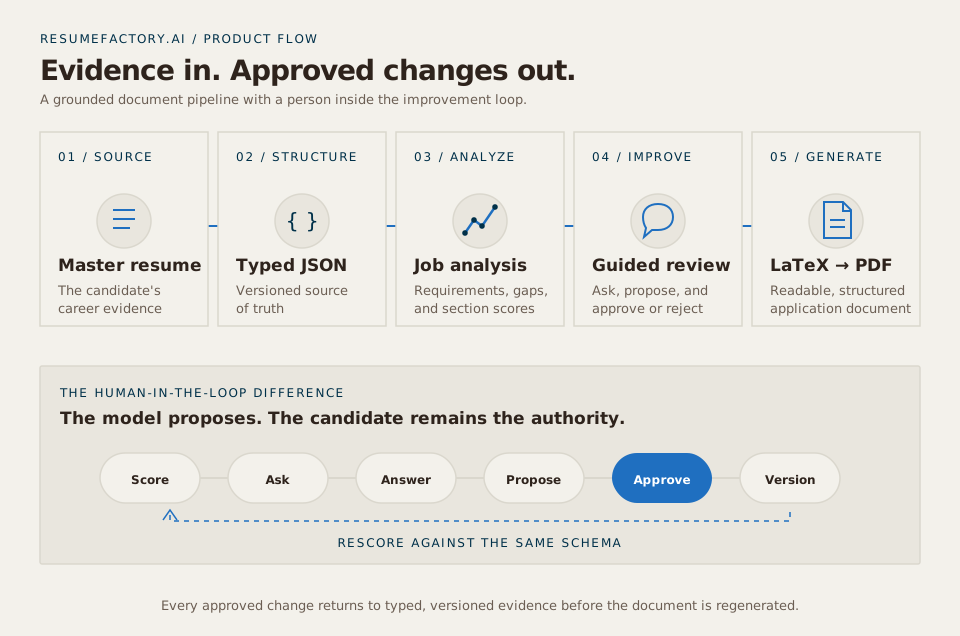
The product kept the model inside a structured improvement loop: score, ask, answer, propose, approve, version, and rescore.
Rather than returning one unexplained match score, the product broke the result into areas such as hard skills, work experience, education, and projects and supplied reasoning for each score.
When the system found a gap, it asked the user structured questions instead of filling the gap itself. It then proposed specific changes, which the user could approve or reject. Each transformation stayed within typed resume sections and explicit instructions not to invent facts. Users could compare versions, inspect the changes, and run the scoring process again.
Approved content flowed into a LaTeX template based on the widely used Jake’s Resume layout. We tested the PDFs by importing them into several job sites and checking whether fields and sections were extracted cleanly. That practical interoperability testing is why we describe the documents as ATS-readable.
What succeeded, and why it closed
ResumeFactory.ai succeeded as both a product and a technical proof. Hundreds of people used it, demonstrating that the text-understanding capabilities of LLMs could support a structured, useful application rather than a one-shot writing demo. The system remained grounded in each person’s real experience, guided users through an explicit review loop, and produced finished documents they could use.
What did not work was the donation-funded business model. Voluntary revenue did not cover inference, infrastructure, and continued development, so I closed the public service in January 2026 rather than continue subsidizing it.
The product proved the technical thesis. It did not establish a sustainable way to pay for the service.
What the project shows
- Structured source data can keep a generative workflow grounded in real evidence.
- Human review works best when it is part of the product flow rather than a warning at the end.
- Schema-based scoring can make an LLM assessment easier to inspect and improve.
- A complete AI product includes the path from uploaded source material to a useful finished document.
- A technically successful product is not necessarily a sustainable business.